

Quick Summary: A kitten age chart by week can help you estimate how old a kitten may be by looking at visible signs like eyes, ears, teeth, weight, movement, and feeding stage. It gives a good guess, not an exact age. For the best estimate, compare several signs together. If the kitten is cold, weak, injured, not eating, or struggling to breathe, contact a vet or rescue first.
If you found a kitten or adopted one without knowing the age, this kitten age chart can help you make a better guess. Of course, it is not exact. Kittens do not all grow at the same speed. But a chart gives you an easy way to compare the signs you can see.
The main signs to check are the eyes, ears, teeth, body weight, movement, and feeding stage. A newborn kitten with closed eyes and folded ears will look very different from a 5 week old kitten with baby teeth, better walking, and interest in wet food.
The important thing is not to rely on one sign only. Kitten weight can help, but weight alone can be misleading. Eye opening can help too, but eyes do not prove the exact age. The better way is to compare a few clues together and use this kitten age chart as a guide.
If you want a faster estimate after checking the chart, you can also use the Kitten Age Calculator.
Kitten Age Chart by Week
This chart gives a general age estimate. Some kittens may be a little ahead or behind. That is normal. Health, food, litter size, breed size, and early care can all affect growth.
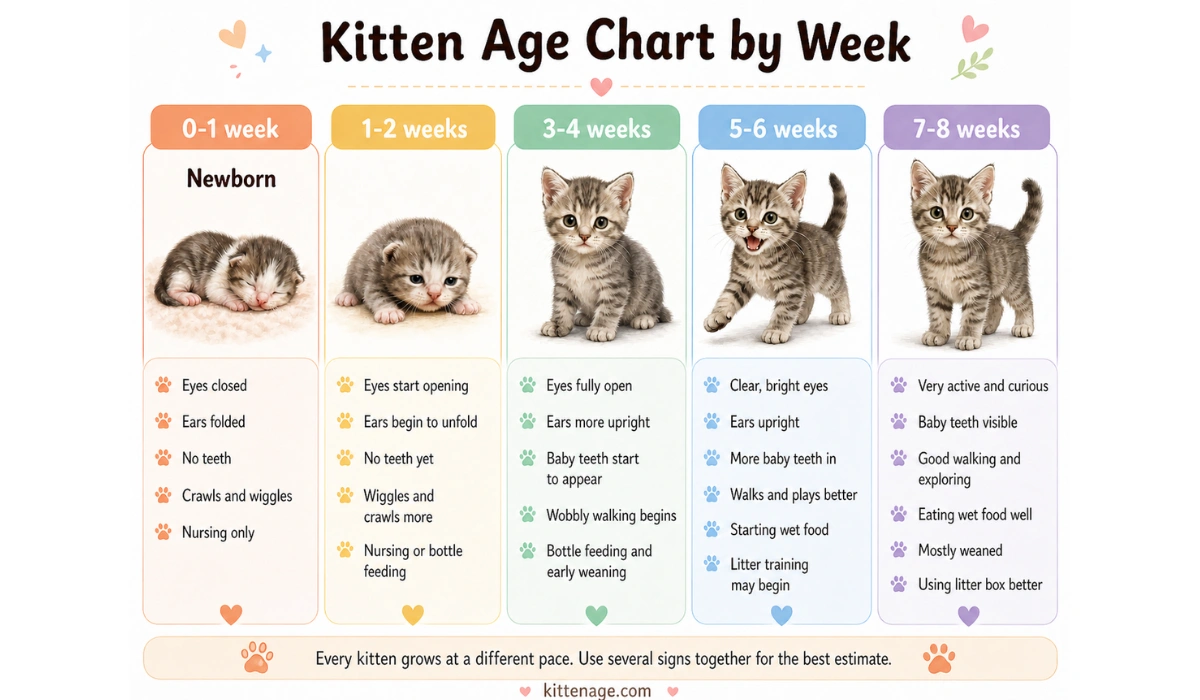
How To Read the Kitten Age Chart
Start with the most obvious signs. Are the kitten’s eyes closed or open? Are the ears folded or more upright? Is the kitten crawling, wobbling, or walking? These first signs can quickly tell you if the kitten is likely newborn, a few weeks old, or older.
Then look for teeth. Teeth can be a very useful clue once they start showing. A kitten with no teeth is usually younger than a kitten with tiny baby teeth. But again, don’t rely on a single clue.
Weight is useful too, but it can trick you. A small kitten is not always younger. The kitten may be underfed, sick, or simply smaller by nature. A bigger kitten may have had better nutrition. So use weight as part of the estimate, not the whole answer.
A simple way to use the chart is this:
- Check eyes and ears first
- Look for baby teeth
- Watch how the kitten moves
- Notice the feeding stage
- Compare the signs to the closest age range
- Use a calculator or vet help if you are unsure
If the signs do not match one row perfectly, don’t panic. That happens. Pick the closest range and keep watching the kitten over the next few days.
Newborn to 2 Weeks: Closed Eyes, Folded Ears, and Full Dependence
Newborn kittens are very helpless. Their eyes are closed. Their ears are folded down. They have no teeth. They cannot walk. Most of the time, they sleep, nurse, and stay close to the mother cat.
A kitten in this stage may only wiggle, crawl a little, or make small sounds. It cannot stay warm well on its own. If the mother cat is not there, the kitten may need help right away. Warmth matters a lot for very young kittens.
This is also the stage where guessing can be risky. A newborn kitten’s care needs are very different from an older kitten’s needs. If you found a kitten with closed eyes and folded ears, it is smart to contact a rescue, shelter, or veterinarian.
Very young kittens may need regular feeding support, but don’t guess if you are unsure. The safer move is to ask someone experienced.
2 to 4 Weeks: Eyes Open, Ears Unfolding, and Wobbly Movement
Around this stage, kittens start to look a little more awake. Their eyes are often open or opening. Their ears begin to unfold and stand up more. They may react more to touch and sound.
But open eyes do not mean the kitten is independent. This is a common mistake. A kitten with open eyes can still be very young. It may still need bottle feeding and warmth, especially if there is no mother cat.
Movement also starts to change. A 2 week old kitten may crawl better than a newborn. A 3 week old kitten may begin wobbly walking. By around 4 weeks, the kitten may start exploring more, though it can still be clumsy.
Baby teeth may start to show during this period too. That makes teeth a helpful clue. If the kitten has open eyes, ears unfolding, and tiny teeth starting to appear, it is likely past the newborn stage.
Still, use careful wording in your mind. “Likely.” “Around.” “Probably.” That is the honest way to estimate kitten age.
4 to 6 Weeks: Baby Teeth, Better Walking, and Early Weaning
From around 4 to 6 weeks, kittens often become much more active. They may walk better, play a little, and show more interest in the world around them. This is the age where people often say, “Oh, now it looks like a kitten.”
Baby teeth are also more useful at this stage. If you can see small teeth, that helps narrow the age range. Teeth are often more helpful than weight once they appear.
Feeding changes may begin too. Some kittens start showing interest in wet food around this general stage, while still needing support. Weaning does not happen in one clean jump. It is a slow change.
You may also notice the kitten starting to understand the litter box. Not perfectly. There can be messes. But the interest may begin as the kitten becomes more mobile and aware.
This stage can vary a lot. Some kittens are bold and active. Some are slower. If the kitten is weak, not eating, or not gaining strength, ask a vet or rescue for help.
6 to 8 Weeks: More Active, More Independent, and Easier to Age
At 6 to 8 weeks, many kittens look more like tiny cats. They walk better, play more, and may try to run, climb, pounce, or chase things. The body still looks small, but the behavior is more active.
Their baby teeth are usually more noticeable by this point. They may be eating kitten food more confidently too. Movement is smoother, and the kitten may show more social behavior.
This stage is often easier to recognize than the newborn stage. The kitten’s eyes are open, ears are upright, teeth are present, and movement is much stronger.
Still, size can vary. Some 8 week old kittens look small. Some younger kittens look bigger. That is why the chart should still be used with more than one sign.
At this stage, behavior and movement can tell you a lot, but size can still vary from kitten to kitten.
8 to 12 Weeks and Older: When the Chart Becomes Less Exact
As kittens get older, age can become harder to estimate by appearance alone. A 10 week old kitten and a 12 week old kitten may look similar to many people. Even a small older kitten may be confused with a younger kitten if you only look at size.
At this stage, teeth, body shape, behavior, and growth pattern may help more than eyes or ears. The eyes and ears are already open and developed enough that they no longer tell you much about the exact week.
Older kittens usually move with more confidence. They play harder, climb more, and interact more like young cats. But again, personality can affect this. A shy kitten may seem younger because it moves less or hides more.
If the kitten is older than this, exact age can be harder to judge by looks alone. You may need to rely more on teeth, body shape, behavior, and a vet’s estimate.
Best Signs To Use for Kitten Age Estimation
Some signs are better at certain ages. Eyes and ears are very useful early on. Teeth become more helpful once they appear. Movement and feeding stage help across several weeks.
| Sign | Best Age Range | Why It Helps | Limitation |
|---|---|---|---|
| Eyes | Birth to about 3 weeks | Closed or open eyes show early development | Not useful for exact age after eyes open |
| Ears | Birth to about 4 weeks | Folded or upright ears help with early age clues | Can vary slightly by kitten |
| Teeth | Around 3 weeks and older | Baby teeth give stronger age clues | No help before teeth appear |
| Weight | All stages | Helps track growth over time | Small size does not always mean young age |
| Movement | 1 to 8 weeks | Crawling, wobbling, and walking show growth stage | Weak kittens may move less |
| Feeding stage | Birth to 8 weeks | Nursing, bottle feeding, and weaning show care stage | Feeding can vary by health and support |
| Litter box use | Around 4 weeks and older | Shows growing control and awareness | Not all kittens learn at the same speed |
The best estimate comes from matching several clues. If the eyes say one thing but the teeth and movement say another, slow down and compare again. Mixed signs happen.
Step-by-Step: How To Estimate Your Kitten’s Age

Start with the eyes. Closed eyes usually mean the kitten is very young. Eyes that are opening or recently opened often suggest the kitten is around the early weeks of life. Open eyes alone do not mean the kitten is ready for solid food or full independence.
Next, look at the ears. Folded ears usually go with very young kittens. Ears that are unfolding or standing more upright suggest the kitten is moving into the next stage.
Then check for teeth if it is safe and easy to do. Do not force the mouth open roughly. If you can see tiny baby teeth, that helps narrow the age range. No teeth usually points to a younger kitten.
Watch the movement. Is the kitten just wiggling? Crawling? Wobbling? Walking well? Movement can tell you a lot. A kitten that runs and plays is in a very different stage from one that can only crawl.
Check the feeding stage too. A kitten that nurses or needs bottle feeding is younger than a kitten eating wet food well. But do not change feeding based only on a guess. If you are unsure, ask a vet or rescue.
You can also weigh the kitten and compare it with other signs. Just don’t make weight the only thing. Weight can be affected by health and nutrition.
Once you have these clues, compare them with the chart. Then use a kitten age calculator if you want a second check.
And if the kitten is cold, weak, injured, not eating, or struggling to breathe, stop worrying about the exact age for the moment. Care comes first.
Common Mistakes When Using a Kitten Age Chart
One mistake is using weight alone. A kitten’s weight can help, but it does not prove age. Small kittens are not always young. Big kittens are not always older.
Another mistake is thinking every kitten grows on the same schedule. They don’t. One kitten may walk earlier. Another may get teeth a little later. Some are active and loud. Some are quiet.
People also forget to check teeth. Teeth can be one of the better clues once they start coming in. If you only look at size and eyes, you may miss a helpful sign.
Another common mistake is ignoring health signs. A weak kitten may act younger because it has less energy. A sick kitten may not move much, even if it is old enough to be more active.
And yes, charts are helpful. But they are still charts. Real kittens can be messy and uneven. That is normal.
When a Kitten Age Chart Is Not Enough
A kitten age chart is useful, but it cannot replace a veterinarian or rescue. It can help you guess age. It cannot tell you if a kitten is sick or safe.
Contact a veterinarian or rescue if the kitten is:
- Cold
- Weak
- Limp
- Injured
- Not eating
- Struggling to breathe
- Crying constantly
- Very quiet and not moving much
- Showing swollen or crusty eyes
- Not gaining strength over time
This is especially important for very young kittens. Newborn kittens can get weak fast. If something feels wrong, it is better to ask for help early.
Also remember this. The chart is an estimate, not a diagnosis. It helps you understand the stage. It does not replace proper care advice.
FAQ about Kitten Age Chart By Week
How can I tell how old my kitten is?
You can estimate your kitten’s age by checking the eyes, ears, teeth, weight, movement, and feeding stage. A chart can help you compare these signs by week. But the result is still an estimate, not an exact age.
Can you tell kitten age by weight?
Weight can help, but it should not be used alone. A kitten may be small because of poor nutrition, illness, breed size, or litter size. Use weight with teeth, eyes, ears, movement, and feeding stage.
Can you tell kitten age by teeth?
Yes, teeth can be one of the better clues once they start coming in. A kitten with no teeth is usually very young. Tiny baby teeth can help narrow the age range. For more detail, use the Kitten Age by Teeth guide.
How old is a kitten with closed eyes?
A kitten with closed eyes is usually very young, often newborn or around the first week of life. But closed eyes alone do not prove the exact age. Check the ears, teeth, movement, and feeding stage too.
What age do kittens start walking?
Kittens usually begin with crawling, then wobbly steps, then better walking as they grow. Many kittens start showing wobbly walking around the early weeks, but the timing can vary. Movement should be compared with other age signs.
When do kittens start eating wet food?
Many kittens begin showing interest in wet food around the weaning stage, often around the middle of the first two months. But timing can vary. If the kitten is very young or weak, ask a vet or rescue before changing feeding.
When should I contact a vet or rescue?
Contact a vet or rescue if the kitten is cold, weak, injured, not eating, struggling to breathe, or has swollen or crusty eyes. Also ask for help if you found a newborn kitten and the mother cat is not around.
Final Thoughts
A kitten age chart is a helpful starting point. It can show you what to look for week by week, from closed eyes and folded ears to baby teeth, walking, wet food, and litter box use.
But kitten age is still an estimate. The chart can guide you but not give an exact birthday. Use more than one sign. Check the eyes, ears, teeth, weight, movement and feeding stage together.
If the kitten seems warm, alert and growing, keep watching the signs and compare them over time. If the kitten is cold, looking weak, injured, not eating, or struggling to breathe, get help from a vet or rescue.
If you are trying to estimate a kitten’s age right now, start with the easiest sign you can see. Is it the eyes, the teeth, the weight, or the way the kitten moves?