
If you weighed a kitten and are now wondering how old it is, that makes you wonder. Weight is one of the first things people check when they find or adopt a young kitten. It feels simple. Put the kitten on a scale, compare the number, and guess the age.
But kitten weight is not always that simple.
A small kitten is not always younger. It may be underfed, sick, or just smaller because of litter size or background. A bigger kitten is not always older either. It may have had better nutrition or a stronger start.
So yes, weight can help. But weight alone cannot confirm the exact kitten age. The better way is to compare weight with other visible signs like eyes, ears, teeth, movement, and feeding stage. That gives you a much safer estimate.
This guide explains how to use kitten weight for age guessing, why weight can be misleading, and when a low or changing weight may need help.
Can You Tell a Kitten’s Age by Weight?
The weight of a kitten may be used to approximate the age, although this can only be done in a rough manner. Weight will give you an idea. It does not provide you with a definite answer.
Young kittens can easily gain weight as they grow and therefore a very small kitten can be very young. However, that is not necessarily the case. Other kittens are tiny because they were fed insufficiently at a tender age. Others are small since they are not in good health. Others are simply smaller in nature.
This is why weight is most effective when used alongside other indicators. An example is a kitten with closed eyes, folded ears, no teeth and a very small body, which is probably very young. A baby with its eyes open, baby teeth, is walking better, has a higher weight and is more likely to be older.
The main thing to remember is this: weight can guess youn an kitten age range but it cannot prove the exact age.
Kitten Weight Chart by Age
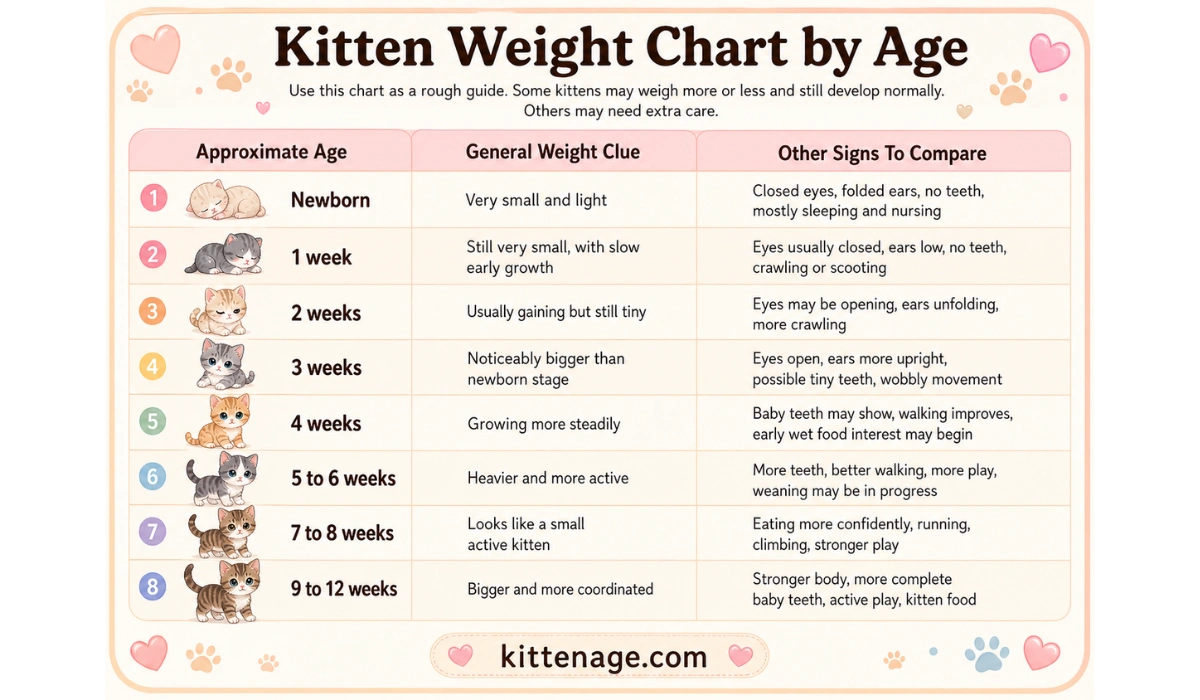
This kitten weight chart should be used as a rough guide. There is no rigid policy. Other kittens will weigh more or less than the ranges below and continue to develop normally. Others might not be within the range since they require additional care.
Why Kitten Weight Can Be Misleading
A kitten that looks tiny may not be younger. It may be underweight. Maybe it missed meals. Maybe it had a rough start. Maybe the mother cat was not able to feed the litter well. In that case, the kitten’s body size may not match the real age.
A bigger kitten can be tricky too. A kitten that had steady nursing, better food, and good early care may weigh more than another kitten the same age.
Breed and body type can also affect size. Some kittens are naturally smaller. Some are built a little bigger. Litter size matters too. Kittens from a large litter may grow differently than kittens from a small litter.
So if the weight says one thing and the teeth or movement says another, do not panic. Mixed signs are common. Slow down and compare everything together.
How To Weigh a Kitten Safely
Weighing a kitten does not need to be complicated. But it should be gentle, especially with tiny kittens.
Here is a easy way to do it:
- Use a small kitchen scale if you have one
- Place a soft towel or small container on the scale
- Reset the scale to zero if possible
- Put the kitten down gently
- Keep one hand nearby so the kitten does not fall
- Write down the weight
- Weigh at the same time each day if you are tracking growth
Do not stress a weak kitten just to get a number. If the kitten is cold, limp, injured, crying weakly, or even not eating, getting help matters more than weighing.
If you are start tracking a kitten over several days, the pattern can be more useful than one number. A kitten that keeps gaining is different from a kitten that is losing weight or not gaining at all.
Newborn to 2 Weeks: Weight Is Only One Early Clue
In the first couple of weeks, weight is only one part of the picture. Newborn kittens are very dependent. Their eyes are closed. Their ears are folded. They have no teeth. They cannot walk.
A newborn or very young kitten may only wiggle, crawl a little, sleep and nurse. If the mother cat is not there, may be the kitten need warmth and regular feeding support.
This is the stage where weight can be helpful, but it should never be the only thing you check. A cold kitten may seem quiet and still. A weak kitten may not move much. That can make age guessing harder.
Look at the full set of signs:
- Closed or opening eyes
- Folded or unfolding ears
- No teeth
- Crawling or weak movement
- Nursing or bottle feeding stage
- Warmth and energy level
If the see kitten feels cold, is not eating, or seems weak, right away contact a vet or rescue.
2 to 4 Weeks: Weight Plus Eyes, Ears, and Teeth
From around 2 to 4 weeks, weight starts to make more sense when you compare it with other changes. The eyes may be open or opening. The ears may unfold more. The kitten may crawl better and start taking wobbly steps.
Tiny baby teeth may also start to appear around this stage. Once teeth show up, they can help confirm that the kitten is past the earliest newborn stage.
Still, kittens in this range can vary. One kitten may be bigger and more active. Another may be smaller and still catching up. That does not always mean the age estimate is wrong.
If the kitten has open eyes, ears that are standing more, tiny teeth, and wobbly movement, weight can support the estimate. But if the kitten’s weight seems low, check the overall condition too. Is the kitten warm? Feeding? Alert? Growing?
That matters more than one number.
4 to 8 Weeks: Weight, Weaning, and More Movement

Between 4 and 8 weeks, kittens usually become much more active. They may walk better, play more, explore more and show interest in wet food.
Weight can be useful here to check age, but it still needs context. A kitten that is eating well and becoming more active may gain steadily. A kitten that is not eating well or seems weak may fall behind.
This is also when baby teeth become easier to notice. Movement improves too. The kitten may start using the litter box with better control. All these signs help you estimate age better than weight alone.
A 6 week old kitten and an 8 week old kitten can sometimes look close in size, especially if one is smaller or larger than average. So check the teeth, movement, feeding stage, and behavior.
If the kitten is losing weight, not eating, or not gaining strength, ask for help. Do not wait too long.
8 to 12 Weeks and Older: Why Weight Gets Less Exact
As kittens get older, weight becomes less exact for age guessing. Older kittens can vary more in body size. Some grow fast. Some stay small for a while. Some are naturally leaner.
At 8 to 12 weeks and older, behavior, teeth, body shape, and movement can help more than weight alone. A kitten may run, climb, jump, and play with more confidence. It may eat kitten food well and seem more like a small young cat.
The problem is that two kittens close in age may still weigh different amounts. That is normal in many cases.
So for older kittens, use weight as one growth clue. Do not use it as the final answer. Look at how the kitten moves, eats, plays, and develops over time.
Weight vs Teeth: Which Is Better for Kitten Age?
Teeth can often be more helpful than weight once they appear. That is because teeth follow a development pattern. Weight can be affected by too many outside things like food, illness, litter size, and early care.
But teeth are not perfect either. They also give an estimate, not an exact age.
A kitten with no teeth and a tiny body is likely very young. A kitten with baby teeth, open eyes, and better movement is likely older. A kitten with more teeth and stronger play is older still.
The best choice is not weight or teeth. It is both together. And even better, both with eyes, ears, movement, and feeding stage.
Weight vs Eyes, Ears, Movement, and Feeding Stage
Weight tells you about size and growth. Eyes, ears, movement, and feeding stage tell you about development. Both matter.
Eyes and ears help most in the early weeks. Closed eyes and folded ears usually point to a very young kitten. Open eyes and unfolding ears suggest the kitten is growing into the next stage.
Movement is another strong clue. A kitten that only wiggles is very different from one that walks and plays. Feeding stage helps too. A kitten that is still nursing or bottle feeding is not in the same stage as a kitten eating wet food.
A better estimate comes from asking:
- What does the kitten weigh?
- Are the eyes open or closed?
- Are the ears folded or upright?
- Are there teeth?
- Is the kitten crawling, walking, or running?
- Is the kitten nursing, bottle feeding, weaning, or eating food?
- Does the kitten seem warm and alert?
That gives you a fuller picture.
Step-by-Step: How To Estimate Kitten Age by Weight

Start by weighing the kitten gently. Write down the number. If you can, weigh again at the same time over the next few days so you can see the pattern.
Then check the eyes. Closed eyes usually suggest a very young kitten. Open eyes mean the kitten is past the earliest newborn stage, but still may be young.
Look at the ears next. Folded ears often go with newborn kittens. More upright ears suggest the kitten is older.
Now check for teeth if it is easy and safe. Do not force the mouth open. If tiny baby teeth are visible, the kitten is likely past the earliest newborn stage.
Watch the movement. A kitten that wiggles or crawls is likely younger than a kitten that walks, runs, and plays.
Check the feeding stage too. Nursing, bottle feeding, wet food, and eating kitten food all point to different growth stages.
Then compare everything together. If the weight does not match the other signs, do not force it. Use the closest range and keep observing.
And if the kitten is cold, weak, injured, not eating, losing weight, or struggling to breathe, get help first. Age guessing can wait.
Common Mistakes When Using Weight To Estimate Age
One common mistake is thinking small means young. Not always. A kitten may be small because it is underweight or had poor early care.
Another mistake is thinking big means older. Also not always. A kitten may weigh more because it had steady food and a good start.
People also sometimes use a weight chart like a strict rule. It is not a strict rule. It is a guide. Real kittens do not always match the chart perfectly.
Another mistake is ignoring teeth and movement. If a kitten has baby teeth and walks well, that matters, even if the kitten is smaller than expected.
The most serious mistake is ignoring health signs. A kitten that is not eating, losing weight, cold, weak, or breathing badly needs help. That is more important than figuring out the exact age.
When a Weight Chart Is Not Enough
A weight chart can help you estimate age, but it cannot tell you if a kitten is healthy. It cannot diagnose why a kitten is small or why it is not gaining.
Contact a vet or rescue if the kitten is:
- Losing weight
- Not gaining strength
- Not eating
- Cold
- Weak
- Limp
- Injured
- Struggling to breathe
- Very quiet and not moving much
- Crying constantly
- Showing signs of poor growth
This guide is for age estimation. It is not a diagnosis. If something feels wrong, ask for help early. Especially with very young kittens.
FAQ About Kitten Age by Weight
Can you tell a kitten’s age by weight?
You can estimate a kitten’s age by weight, but it will only be a rough guess. Weight should be compared with eyes, ears, teeth, movement, and feeding stage.
How much should a kitten weigh by age?
Kitten weight can vary by age, food, health, breed size, and litter size. A chart can give a general range, but it should not be treated as exact.
How much does a newborn kitten weigh?
A newborn kitten is usually very small and light. But instead of using weight alone, check other signs too, like closed eyes, folded ears, no teeth, and weak movement.
Is my kitten small for its age?
Maybe, but size alone does not prove age or health. A kitten can be small because of nutrition, illness, litter size, or natural body size. If the kitten is weak, not eating, or losing weight, contact a vet or rescue.
Is weight or teeth better for estimating kitten age?
Teeth can be more helpful once they appear, but teeth are not exact either. The best estimate comes from using weight, teeth, eyes, ears, movement, and feeding stage together.
How do I weigh a kitten safely?
Use a small kitchen scale, place a soft towel or container on it, and keep the kitten supported. Weigh at the same time each day if tracking growth. Do not stress a weak or cold kitten just to get a number.
When should I contact a vet about kitten weight?
Contact a vet or rescue if the kitten is losing weight, not eating, cold, weak, injured, not gaining strength, or struggling to breathe. Very young kittens can become weak quickly.
Final Thoughts
Kitten age by weight can be helpful, but it is only one clue. Weight can suggest an age range, but it cannot tell the exact age by itself.
Use weight with other signs. Check the eyes, ears, teeth, movement, feeding stage, and overall energy. If the signs line up, your estimate will be better. If they do not line up, that is okay too. Kittens do not always grow in a perfect pattern.
And if the kitten is cold, weak, injured, losing weight, not eating, or breathing badly, get help from a vet or rescue. The number on the scale matters, but the kitten’s safety matters more.