
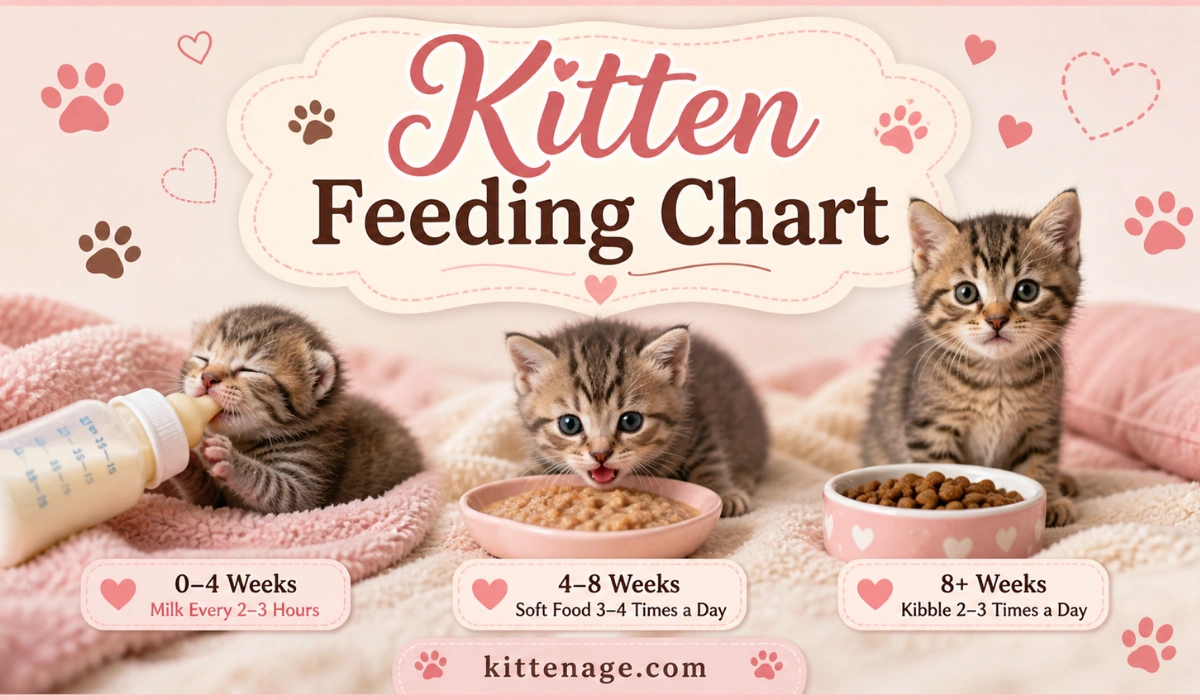
A kitten feeding chart by age helps you understand what kittens usually eat as they grow. Newborn kittens usually need mother’s milk or proper kitten milk replacer. As they get older, they may slowly move toward wet food, weaning, and then kitten food.
If you found a kitten or adopted one without knowing the age, feeding can feel confusing. You may wonder if the kitten needs milk, wet food or regular kitten food. And honestly, it is not always obvious at first.
A kitten’s feeding stage is closely linked to age. A newborn kitten with closed eyes and no teeth is in a very different stage from a 6 week old kitten with baby teeth, better walking, and interest in wet food.
But age is not the only thing that matters. A kitten’s condition matters too. A tiny kitten that is cold or weak should not be treated the same as a warm, active kitten. This is why feeding charts are helpful, but they are still only a guide.
The best way to use this kitten feeding chart by age is to compare feeding stage with other signs like teeth, eyes, movement, weight, and energy level. If something seems wrong, it is safer to ask a vet or rescue.
Before Feeding: Safety Comes First
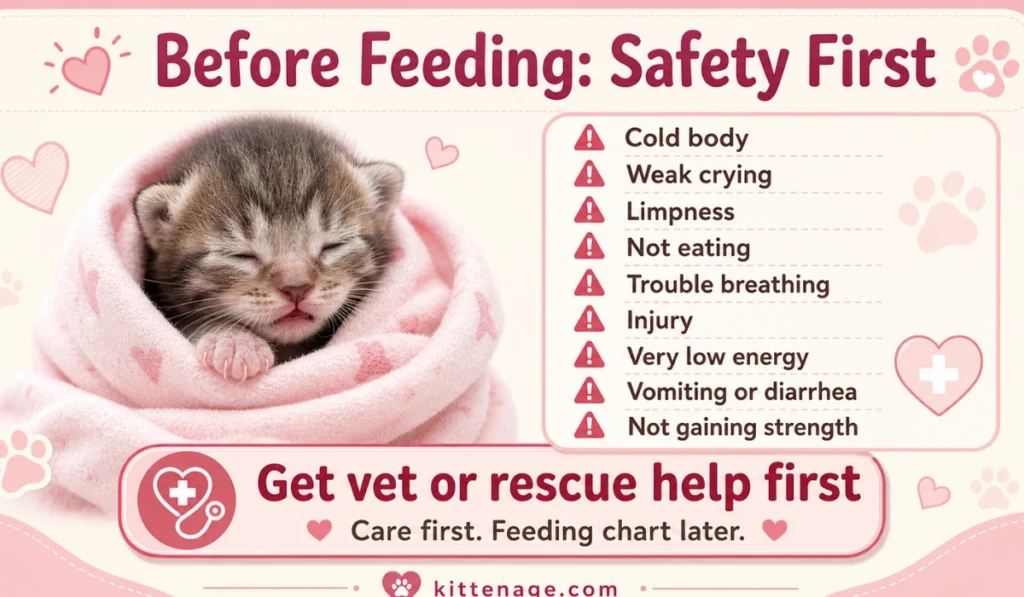
Before thinking about what to feed a kitten, first check if the kitten seems stable. This matters a lot for very young kittens.
If the kitten feels cold, weak, limp, injured, or is struggling to breathe, get help. A kitten that is not eating or is getting weaker should not be ignored.
A few warning signs to watch for:
- Cold body
- Weak crying
- Limpness
- Not eating
- Trouble breathing
- Injury
- Very low energy
- Vomiting or diarrhea
- Not gaining strength
This guide can help you understand feeding stages, but it cannot replace help from a veterinarian or rescue. For fragile kittens, care comes first. The feeding chart can wait a little.
Kitten Feeding Chart by Age
Use this chart as a general guide. Kittens do not all move through feeding stages on the exact same day. Some are ready for wet food earlier. Some need more time. Some need extra support because of health, size, or early care.
| Kitten Age | Usual Feeding Stage | Common Signs | Notes |
|---|---|---|---|
| Newborn to 2 weeks | Mother’s milk or proper kitten milk replacer | Closed eyes, folded ears, no teeth, weak movement | Very young kittens need warmth and close care |
| 2 to 4 weeks | Still milk feeding, early development signs | Eyes opening, ears unfolding, crawling, maybe tiny teeth | Open eyes do not mean ready for solid food |
| 3 to 5 weeks | Early weaning may begin | Baby teeth, more movement, interest in soft food | Weaning is slow and varies by kitten |
| 5 to 8 weeks | Wet food and kitten food become more common | Better walking, more teeth, play, litter box interest | Kittens may eat more on their own |
| 8 to 12 weeks and older | Kitten food and water | Active, playful, stronger movement, better eating | Still needs kitten-appropriate food |
Remember: This chart should not be used as a strict rule. A kitten may have open eyes but still need milk feeding. A kitten may show interest in wet food but still not eat enough on its own. Look at the whole kitten, not just one sign.
Newborn to 2 Weeks: Milk Feeding Stage
Newborn kittens are fully dependent. Their eyes are closed. Their ears are folded. They have no teeth. They cannot walk, and they spend most of their time sleeping and nursing.
At this stage, kittens usually rely on the mother cat’s milk. If the mother cat is not around, a proper kitten milk replacer is usually needed. Cow’s milk is not a safe choice for young kittens.
This age can be risky if the kitten is alone, cold, or weak. A newborn kitten may need warmth and regular feeding support, but do not guess if you are unsure. A rescue or vet can guide you based on the kitten’s age and condition.
Open food dishes, wet food, or dry food are not for this stage. A kitten with closed eyes and no teeth is usually far too young for that.
2 to 4 Weeks: Still Milk Feeding, But More Development Signs
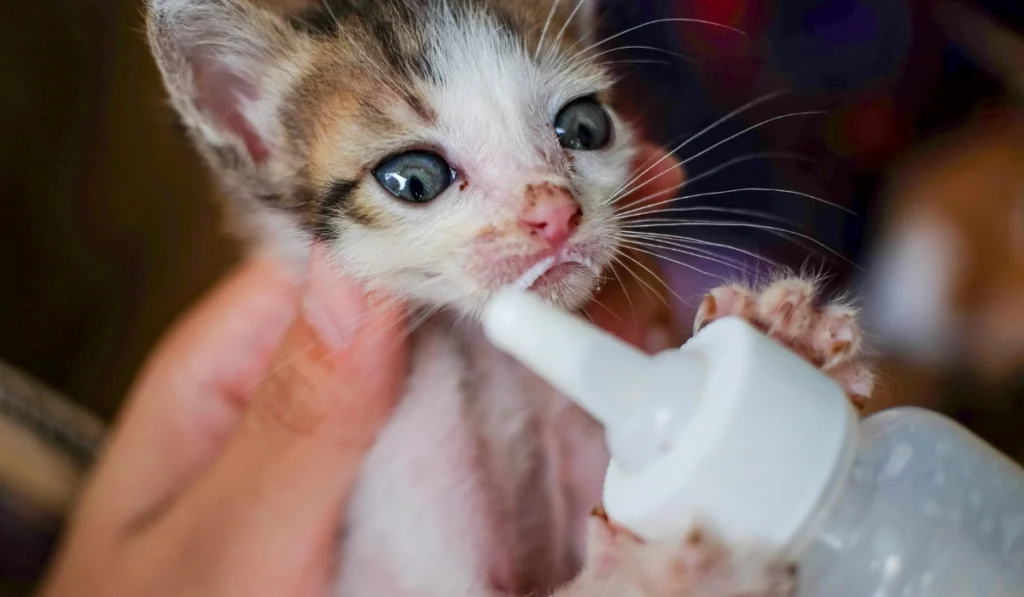
Around 2 to 4 weeks, kittens start changing fast. Their eyes may open. Their ears may unfold more. They may crawl better and begin taking wobbly little steps.
But this is where people often make a mistake. Open eyes do not mean the kitten is ready to eat like an older kitten. A kitten with open eyes can still be very young and may still need milk feeding.
Tiny baby teeth may start showing during this time. That can be a sign the kitten is moving toward the next stage, but it does not mean weaning is complete.
Some kittens may begin to show interest in food near the later part of this stage. Some may not. That is normal. Go by the kitten’s signs, not just the number of weeks you think it is.
3 to 5 Weeks: Early Weaning May Begin
Around 3 to 5 weeks, some kittens begin showing interest in soft wet food. This is the early weaning stage. It is not a clean switch from milk to food. It is more like a slow messy change.
And yes, messy is normal. A kitten may lick food, step in it, wear it on the face, and eat only a little at first. That does not always mean something is wrong. Kittens learn.
Baby teeth are one of the signs that weaning may begin soon. Better movement can also be a clue. A kitten that is starting to walk, explore, and show interest in food may be moving into this stage.
Still, not every kitten is ready at the same time. A smaller or weaker kitten may need more help. A kitten that is not eating enough should be checked by someone experienced.
5 to 8 Weeks: Wet Food, Kitten Food, and More Independence
From 5 to 8 weeks, many kittens eat more wet food and become more active. They may walk better, play more, and explore more. Their baby teeth are usually easier to see too.
This is often when kittens start looking like tiny cats. They may chase toys, climb things, and show more personality. Feeding also becomes more independent for many kittens.
Some kittens may still be learning. They may eat wet food well one day and seem less interested the next. They may still need help building a steady routine. That can happen.
Water may become part of the routine too as kittens eat more kitten food. Litter box habits often improve around this stage, but young kittens can still have accidents.
The main thing is to watch the whole kitten. Is it eating, active, warm, and growing? Or is it weak, quiet, and not improving? That difference matters.
8 to 12 Weeks and Older: Eating More Like a Young Kitten
By 8 to 12 weeks, many kittens are eating kitten food more confidently. They usually move better, play more, and act more like young cats.
At this stage, food should still be kitten-appropriate. Kittens are growing, so they are not the same as adult cats. They need food made for kittens, not random table food or adult cat food as the main diet.
Most kittens in this stage are more coordinated. They may run, climb, jump, and play hard. They may also sleep hard after all that chaos. Normal kitten stuff.
Even here, kittens can vary. Some are bigger. Some are smaller. Some are bold. Some are shy. Feeding stage can help you understand age, but it is not the only clue.
Feeding Stage as an Age Clue
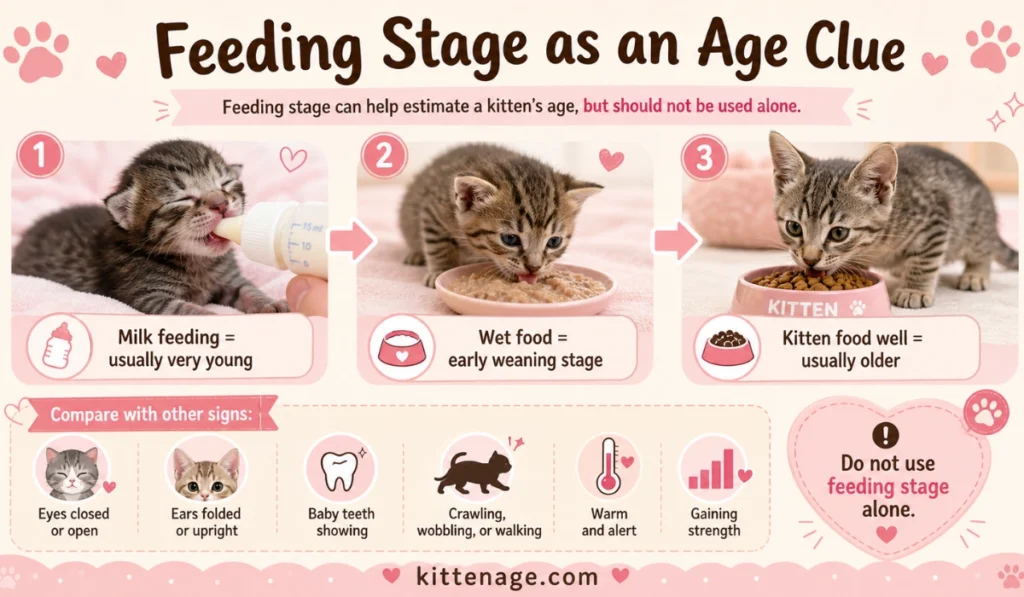
The feeding stage can help estimate kitten age, but it should not be used alone.
A kitten that needs milk feeding is usually very young. A kitten that is starting wet food may be in the early weaning stage. A kitten eating kitten food well is usually older.
But the tricky part is this. Feeding behavior can be affected by health, stress, weakness, or early care. A kitten that is old enough for wet food may still not eat well if it is sick or weak. A kitten that shows interest in food may still need support.
So compare feeding stage with other signs:
- Are the eyes closed or open?
- Are the ears folded or upright?
- Are baby teeth showing?
- Is the kitten crawling, wobbling, or walking well?
- Is the kitten warm and alert?
- Is the kitten gaining strength?
If you want to compare feeding stage with other age signs, use a kitten age chart to check eyes, ears, teeth, weight, and movement together.
What Not To Feed a Young Kitten
Some feeding mistakes are common. They usually happen because people are trying to help fast. The intention is good, but the choice can still be unsafe.
Avoid giving young kittens:
- Cow’s milk
- Random human food
- Adult cat food as the main diet
- Hard food before the kitten is ready
- Food by force
- Anything if the kitten is cold, weak, or struggling without asking for help
Cow’s milk is one of the big ones. Many people think it is normal for kittens, but it is not a good choice for young kittens.
Also, do not force food into a kitten’s mouth. If the kitten is too weak to eat or seems unable to feed, contact a vet or rescue. Forcing food can make things worse.
How To Know If a Kitten May Be Ready for Wet Food
A kitten may be getting close to wet food when a few signs start showing together. Not one sign. A few signs.
Possible signs include:
- Baby teeth are starting to show
- The kitten is more alert
- The kitten is walking or trying to walk
- The kitten shows interest in soft food
- The kitten can lick or taste food
- The kitten is moving into the weaning stage
Even then, weaning takes time. A kitten may taste wet food but still need milk feeding. That is normal in the early stage.
If the kitten is weak, cold, not eating, or seems too young, do not push wet food just because a chart says it may be time. Charts are general. Real kittens need care based on their condition.
Since baby teeth are one of the signs of weaning, a kitten age chart by teeth can also help you understand whether the kitten may be moving into the next stage.
Common Mistakes With Kitten Feeding by Age
One common mistake is feeding based only on guessed age. If you guess wrong, the kitten may not be ready for that food stage.
Another mistake is assuming open eyes mean the kitten can eat wet food. Open eyes are a development sign, but they do not mean the kitten is ready for full weaning.
Cow’s milk is another mistake. It is not the right milk for kittens.
Some people also try to force food when a kitten does not eat. That can be dangerous. If a kitten is not eating, especially a very young kitten, get help.
Another mistake is ignoring weakness. A kitten that is cold, limp, very quiet, or not gaining strength needs more than a feeding chart. It needs proper help.
When a Feeding Chart Is Not Enough
A feeding chart is useful, but it cannot tell you if a kitten is sick or safe. It also cannot replace a vet or rescue.
Contact a vet or rescue if the kitten is:
- Cold
- Weak
- Limp
- Injured
- Not eating
- Losing strength
- Struggling to breathe
- Crying constantly
- Very quiet and not moving much
- Vomiting or having diarrhea
- Not growing or gaining strength
This matters most for newborn and very young kittens. They can get weak quickly. If something feels wrong, ask for help early.
FAQ About Kitten Feeding Chart
What should I feed a kitten by age?
Very young kittens usually need mother’s milk or proper kitten milk replacer. As kittens grow, they may slowly move toward soft wet food, weaning, and kitten food. The exact stage depends on age, teeth, movement, and condition.
What do newborn kittens eat?
Newborn kittens usually nurse from the mother cat. If orphaned, they usually need proper kitten milk replacer with help from someone experienced. Cow’s milk is not suitable for newborn kittens.
When do kittens start eating wet food?
Many kittens start showing interest in wet food during the early weaning stage, often around the middle of the first two months. Timing can vary. Baby teeth, better movement, and interest in food can be signs.
Can kittens drink cow’s milk?
No. Cow’s milk is not a good choice for kittens. Very young kittens need mother’s milk or proper kitten milk replacer if they are orphaned. If you found a very young kitten, contact a vet or rescue for guidance.
When do kittens stop bottle feeding?
Kittens usually move away from bottle feeding during weaning, but it does not happen in one day. Some kittens need more time than others. Feeding stage should be judged with age signs, teeth, movement, and overall health.
How do I know if a kitten is ready to wean?
A kitten may be ready to begin weaning when baby teeth show, movement improves, and it starts showing interest in soft food. But weak or very young kittens may need help. Do not rush the process.
When should I contact a vet if a kitten is not eating?
Contact a vet or rescue if a kitten is not eating, especially if it is very young. Also get help if the kitten is cold, weak, injured, limp, losing strength, or struggling to breathe.
Final Thoughts
A kitten feeding chart by age can help you understand what kittens usually eat as they grow. Newborn kittens are usually in the milk feeding stage. Older kittens slowly move toward wet food, weaning, and kitten food.
But every kitten is a little different. Use feeding stage with other signs like teeth, eyes, weight, movement, and energy level. That gives you a better idea of what stage the kitten may be in.
And if the kitten is cold, weak, injured, not eating, or struggling to breathe, get help first. Feeding charts are helpful, but the kitten’s safety matters more.